The history of technology is often a story of democratisation, but we are about to witness a divorce.
For the last two decades, "software" was a relatively monolithic concept regarding quality expectations. Whether you were using a social media app or an enterprise resource planning (ERP) tool, the code was handcrafted by humans, debugged by humans, and held to a standard of "it should work as intended."
But as AI takes the wheel of development, the market is splitting in two. We are entering the era of The Great Code Decoupling, where software quality will bifurcate based on a single question:
There are valuable pointers from the translation market - machine translation tools have been available for many years (Google Translate and the like), with the LLM tools not representing a large advance over the pre-existing tools. However, the hype around AI seems to have given 'cover' to lower expectations around quality, with the resulting decimation of the translation market except areas where correctness is essential, e.g. court proceedings, pacemaker manuals etc. In other words, the quality remains where it must (and is still driven by humans) with the general lowering of standards and costs in other areas.

Consumer Grade: The Rise of "Good Enough"
In the consumer world, the pressure is on feature velocity and zero-cost entry. If a fitness app’s new AI-generated social feature glitches and misses a "like," or if a photo-filtering tool has a slight UI misalignment, the user might be annoyed, but they won't switch providers. As AI lowers the barrier to entry, we will see a flood of LLM-generated apps. These will be hyper-personalized, i.e. built specifically for niche user needs.
They'll be cheap/free, developed with minimal human oversight, and they'll be functionally "fuzzy". They'll work 95% of the time, and we will learn to live with the 5% "hallucination" rate as a trade-off for convenience. In this sector, where quality can drop to save costs, it will.
B2B: The Luxury of Correctness
On the other side of the rift lies the world of B2B and infrastructure. In enterprise software, the "5% error" isn't a glitch. Instead, it’s a catastrophic data corruption, a compliance failure, a leak of keys or a multi-million dollar accounting error. Business software cannot afford to be "fuzzy." This will create a premium tier of software development characterised by:
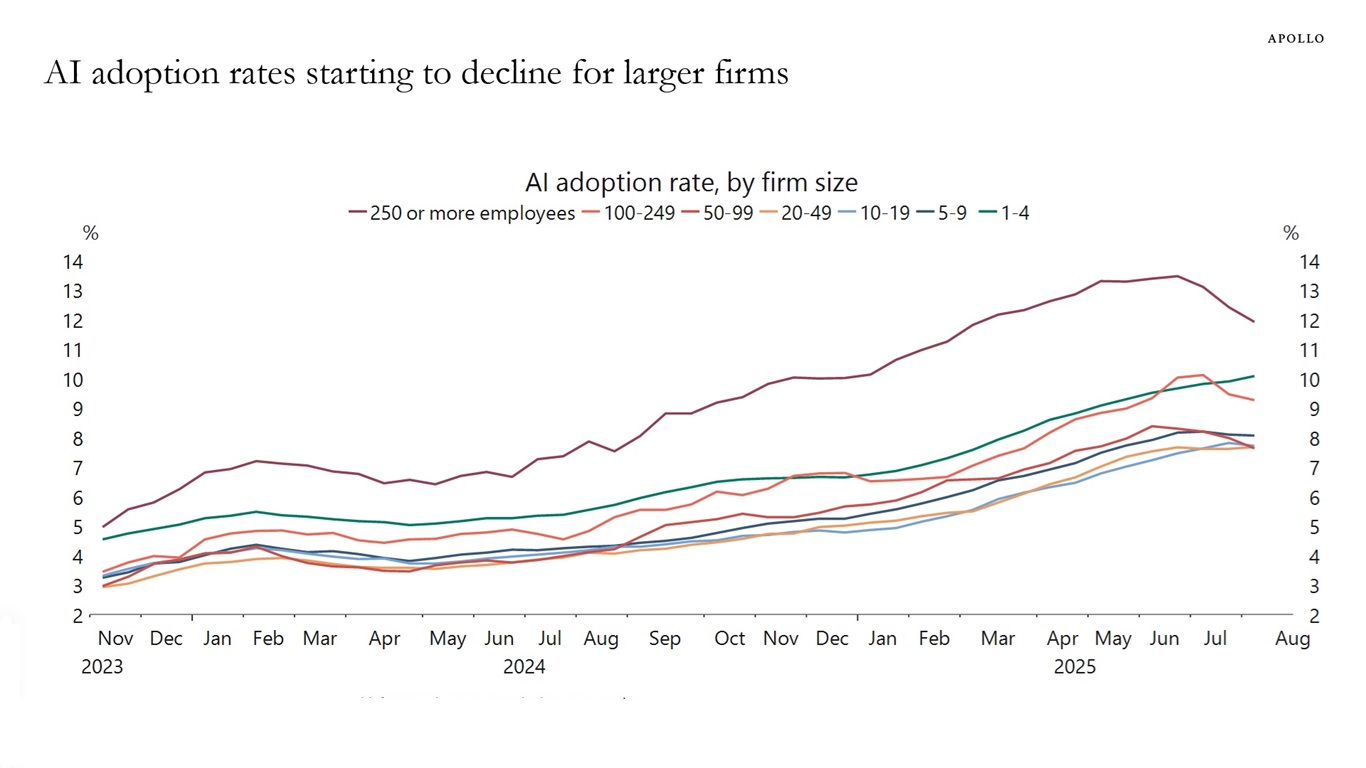
Naturally, developers of B2B software are going to use AI tools for engineering too, but this will lead to expectations of higher quality for the same price, as opposed to the opposite expectation for consumer software. Recent studies seem to back up this thesis, e.g. the US Census Bureau figures from late 2025 showing that large corporations are decreasing their use of AI the most.
The New Luxury: Hand-Coded Logic
We are moving toward a world where "Hand-Coded" might become a mark of quality, similar to "Organic" or "Hand-Stitched." The bifurcation means that for the average user, software will become more abundant but less reliable. The average consumer is going to be swamped by buggy, unsupported 'enshittified' apps which will become disposable. For the enterprise user, software will remain stable but become exponentially more expensive relative to the consumer tier. Expectations for enterprise software quality will increase, with bugs and failures becoming increasingly intolerable.
What is the cost of being 5% wrong?
There are valuable pointers from the translation market - machine translation tools have been available for many years (Google Translate and the like), with the LLM tools not representing a large advance over the pre-existing tools. However, the hype around AI seems to have given 'cover' to lower expectations around quality, with the resulting decimation of the translation market except areas where correctness is essential, e.g. court proceedings, pacemaker manuals etc. In other words, the quality remains where it must (and is still driven by humans) with the general lowering of standards and costs in other areas.
Consumer Grade: The Rise of "Good Enough"
In the consumer world, the pressure is on feature velocity and zero-cost entry. If a fitness app’s new AI-generated social feature glitches and misses a "like," or if a photo-filtering tool has a slight UI misalignment, the user might be annoyed, but they won't switch providers. As AI lowers the barrier to entry, we will see a flood of LLM-generated apps. These will be hyper-personalized, i.e. built specifically for niche user needs.
They'll be cheap/free, developed with minimal human oversight, and they'll be functionally "fuzzy". They'll work 95% of the time, and we will learn to live with the 5% "hallucination" rate as a trade-off for convenience. In this sector, where quality can drop to save costs, it will.
B2B: The Luxury of Correctness
On the other side of the rift lies the world of B2B and infrastructure. In enterprise software, the "5% error" isn't a glitch. Instead, it’s a catastrophic data corruption, a compliance failure, a leak of keys or a multi-million dollar accounting error. Business software cannot afford to be "fuzzy." This will create a premium tier of software development characterised by:
- Predictability over Novelty: While consumer apps chase the latest AI trend, B2B tools will prioritise deterministic outcomes.
- Enhanced Verification and Testing: Rigorous, human-led testing that AI cannot yet replicate reliably.
- Liability Guarantees: Companies will pay more for software that comes with a "correctness" insurance policy.
Naturally, developers of B2B software are going to use AI tools for engineering too, but this will lead to expectations of higher quality for the same price, as opposed to the opposite expectation for consumer software. Recent studies seem to back up this thesis, e.g. the US Census Bureau figures from late 2025 showing that large corporations are decreasing their use of AI the most.
The New Luxury: Hand-Coded Logic
We are moving toward a world where "Hand-Coded" might become a mark of quality, similar to "Organic" or "Hand-Stitched." The bifurcation means that for the average user, software will become more abundant but less reliable. The average consumer is going to be swamped by buggy, unsupported 'enshittified' apps which will become disposable. For the enterprise user, software will remain stable but become exponentially more expensive relative to the consumer tier. Expectations for enterprise software quality will increase, with bugs and failures becoming increasingly intolerable.
The gap between "it mostly works" and "it must work" is about to become a canyon.